
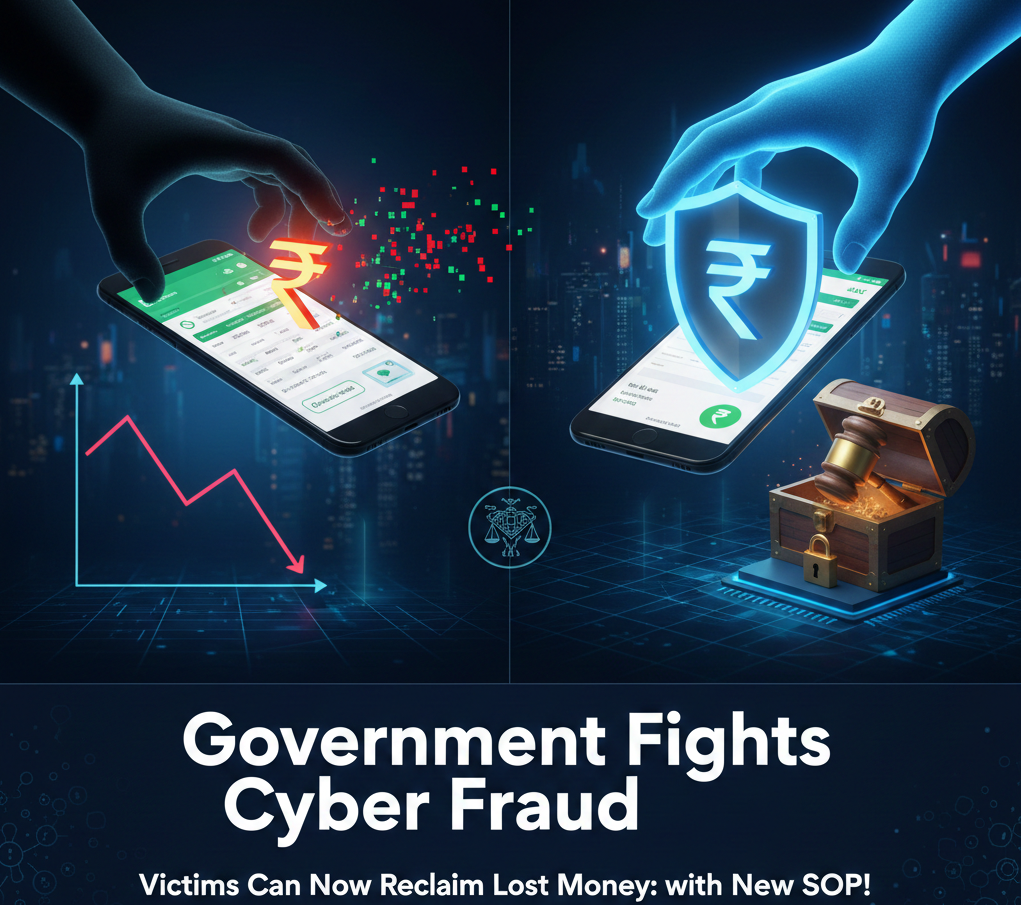
New Government SOP for Victims of Digital Financial Fraud
In recent years, online banking, UPI, mobile wallets, and e-commerce have made our lives easier. However, this convenience has brought a significant risk: cyber financial fraud. Messages like “Click the link,” “Update your KYC,” “You have won a lottery,” or “Double your money in 30 days” are claiming thousands of victims. It is becoming common for a lifetime of savings to vanish in a single moment.
Currently, victims often have to run between police stations, banks, and courts for years to recover their money. To solve these issues, the Ministry of Home Affairs, Government of India, has introduced a new “Standard Operating Procedure” (SOP) for the refund of defrauded money and grievance redressal. Simply put, this is a manual on how police, banks, and financial institutions should act when cyber fraud occurs.
A key principle of this SOP is: “An innocent person should not face unnecessary trouble”. This article covers the scope, objectives, guiding principles, and the complaint and redressal processes of this new SOP. I have written previously on various types of financial frauds, do check them out.
Main Objectives of the SOP
- Saving, holding, and returning the defrauded victim’s money.
- Fairly unfreezing accounts that were frozen by mistake.
- Establishing a clear system of accountability between banks, police, and payment companies.
- Appointing special officers to hear public grievances.
Scope: Who does this apply to?
This SOP applies specifically to cases involving online financial fraud. Key areas include:
- Holding Funds: How to temporarily hold money in accounts involved in fraud.
- Freezing Accounts: How to stop and restart digital banking services for specific accounts.
- Returning Money: Five specific processes for victims to recover their funds.
- Grievance Redressal: A system for those whose accounts were frozen by mistake to file a complaint.
- Unclaimed Funds: How to dispose of money that no one has claimed.
This SOP only applies to cases reported through cybercrime.gov.in, the 1930 helpline, or a police station.
SOP Guiding Principles
- Legal Authority: Police can hold funds under sections 168, 94, and 106 of the Bharatiya Nagarik Suraksha Sanhita (BNSS).
- Careful Reporting: Police must only submit genuine cybercrime cases to the system and prevent false or motivated complaints.
- Prompt Action: Banks must immediately place a hold on reported transactions.
- Bank Accountability: All financial institutions must follow Anti-Money Laundering (AML) rules and conduct enhanced verification on suspicious accounts.
- Victim Rights: Victims should not be subjected to unnecessary hardship during the refund process.
- Multiple Victims: If funds from multiple victims are mixed in one account, a principle of equitable or pro-rata distribution is applied.
The Complaint Process
A victim can report cyber fraud in four ways:
- National Cybercrime Reporting Portal (NCRP): Visit cybercrime.gov.in, register with your email and mobile, and provide full fraud details to receive a 14-digit acknowledgment number.
- 1930 Helpline: Call 1930 to provide details and receive a 14-digit acknowledgment; follow the SMS instructions to complete the report online.
- Through the Bank: Contact a designated bank official who can register the complaint on your behalf at cybercrime.gov.in.
- At a Police Station: Visit any station where an officer will register the complaint in the CFCFRMS (Citizen Financial Cyber Fraud Reporting and Management System).
What happens after a complaint is filed?
Once a police officer confirms the fraud, the case is submitted to the CFCFRMS. Notices are sent to relevant institutions under BNSS sections 168 and 94. Banks must then hold the reported funds and stop digital services like UPI, NEFT, and ATM access. This hold is a temporary investigative measure, not a permanent one.
Additional measures include:
- E-commerce: Companies must cancel undelivered orders and hold the funds; for delivered orders, they must provide recipient details.
- Wallets & Payments: Providers (Paytm, PhonePe, etc.) must hold funds or provide merchant details if used for goods/services.
- Crypto Exchanges: Must hold INR balances or convert crypto back to INR on police instructions and provide wallet details.
- Stock & Mutual Funds: Companies must hold trading balances or specific assets like shares and mutual funds.
If there is only one complaint against an account and the amount is under 50,000, the police can order the release of funds directly. If there are multiple victims, funds are distributed proportionally; if ownership is unclear, a court order is required.
This SOP aims to strengthen the financial system while ensuring equality, transparency, and the protection of citizens’ fundamental rights.
