
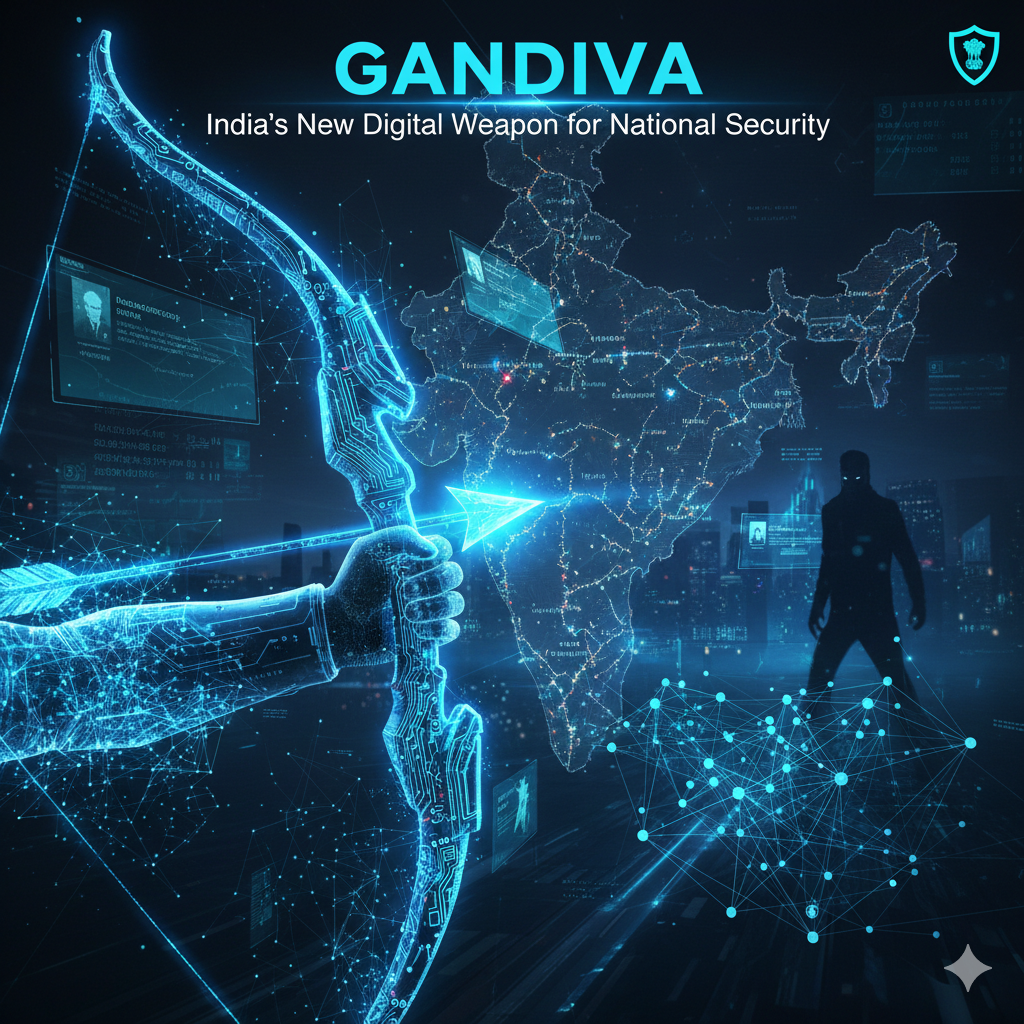
“Gandiva”: India’s New Digital Weapon for National Security
The bow named ‘Gandiva’ in Arjuna’s hands during the Kurukshetra war of the Mahabharata was invincible. Today, in the digital era of the 21st century, the Government of India has integrated an extraordinary Artificial Intelligence (AI) technology of the same name into the national security system. This is not just software; it is a sophisticated ‘digital brain’ operating atop India’s National Intelligence Grid (NATGRID).
This technology marks a milestone in building a crime-free and terrorism-free India. Essentially, the central government has deployed an AI layer called “Gandiva” over the NATGRID data network. This software helps pinpoint criminal details hidden amidst vast oceans of data. As India builds one of the world’s largest data and intelligence systems, this article explains what Gandiva is, how it works, its current stage, its benefits for the government and citizens, and the associated privacy concerns.
What is Gandiva?
Following the 2008 Mumbai terror attacks, the government identified a major problem: while various departments held information, there was no system to consolidate and utilize it. Information exchange between agencies like the NIA, RAW, or IB relied on outdated methods. NATGRID was established to bridge this gap.
NATGRID collects information from approximately 21 different sources in our country, including bank accounts, passports, phone records, and vehicle registrations. While NATGRID was initially a data-linking system, Gandiva transforms it into an “intelligent” system. Gandiva is a “digital brain”—an AI-based analytical system built upon NATGRID data. Named after Arjuna’s bow for its precision and power, it analyzes massive amounts of data to find links and assists investigative agencies in tracking crimes and criminals.
How Does “Gandiva” system Work?
Gandiva utilizes the NATGRID data network for several critical functions:
- Identification of Individuals: If a criminal holds bank accounts or SIM cards under different names, this technology compares addresses or photos to confirm they are the same person.
- Suspicious Behavior Tracking: For example, if a person unexpectedly receives money from abroad and immediately purchases chemicals used for explosives, Gandiva sends an immediate alert to investigative agencies.
- Real-Time Surveillance: It has the capability to inform police the moment a suspect arrives at an airport or checks into a hotel.
- Entity Resolution: If a person provides addresses with different names or minor variations, the technology confirms their identity through photos, birth dates, or biometrics.
- Pattern Recognition: It recognizes specific patterns criminals often follow, such as sudden increases in money transfers in a specific region or unusual internet activity.
- 360-Degree Profiling: Using data like the National Population Register (NPR) and Aadhaar, the system presents a complete social and economic profile of an individual to investigators.
Role in Preventing Cybercrime :-
As “digital arrests” and bank frauds increase, Gandiva helps stop them by:
- Money Trail: It immediately tracks the bank accounts where cyber-looted money has been transferred and assists in freezing them.
- Detecting Fake Documents: It helps identify and cancel millions of SIM cards obtained through fraudulent documents.
- Identifying Cybercriminals: By linking IP addresses, SIM data, and bank transactions, it assists police in locating cyber offenders.
Benefits to Government and Citizens :-
- Counter-Terrorism: It helps prevent the recurrence of events like the Mumbai attacks by detecting suspicious activities early and identifying terror network financial, communication, and movement patterns.
- Rapid Investigation: Data analysis that previously took months or weeks can be completed in seconds. This saves time, effort, and resources for investigators.
- Economic Security: It strengthens the economy by preventing tax evasion and money laundering.
- Fighting Organized Crime: Gandiva is useful for finding links between members of complex networks involved in drug trafficking, Hawala, and illegal money transfers.
- Inter-State Coordination: It enables rapid information exchange between different state police organizations, making it easier to investigate crimes that cross state borders.
- Locating Missing Persons: Facial recognition technology and NATGRID information systems can assist in finding missing individuals.
- Victim Protection: It tracks defrauded money in real-time, allowing agencies to hold the funds and return them to victims.
Privacy and Civil Liberty Concerns :-
Serious and valid concerns are being raised regarding the Gandiva and NATGRID systems:
- Lack of Legal Framework: NATGRID began operating without a specific parliamentary act to determine its powers, limits, or accountability. It is also exempt from the RTI Act, making public scrutiny impossible.
- Data Access Without an FIR: Agencies can access private data even before an FIR is filed. This raises fears of violating the fundamental “Right to Privacy” established by the Supreme Court.
- Mass Surveillance Risks: By linking the NPR data of over 1.19 billion people, the system creates a digital map of the entire population, potentially leading to mass surveillance.
- Potential for Misuse: Concerns exist regarding the misuse of this power against political opponents, journalists, or human rights activists. There is also the risk that an innocent person might suffer if the AI makes an error.
- Lack of Independent Oversight: While information requests are logged, critics argue that without parliamentary or judicial oversight, these logs are mere formalities.
The Way Forward
The Gandiva tool itself is not inherently bad, but power without oversight is dangerous. To truly benefit the people, a clear parliamentary law must be formulated, and an independent judicial oversight committee should be formed to verify the propriety of data requests. Ultimately, Gandiva is a question of democratic values; while building an intelligence network is a welcome step for security, it must not come at the cost of civil liberties.
