
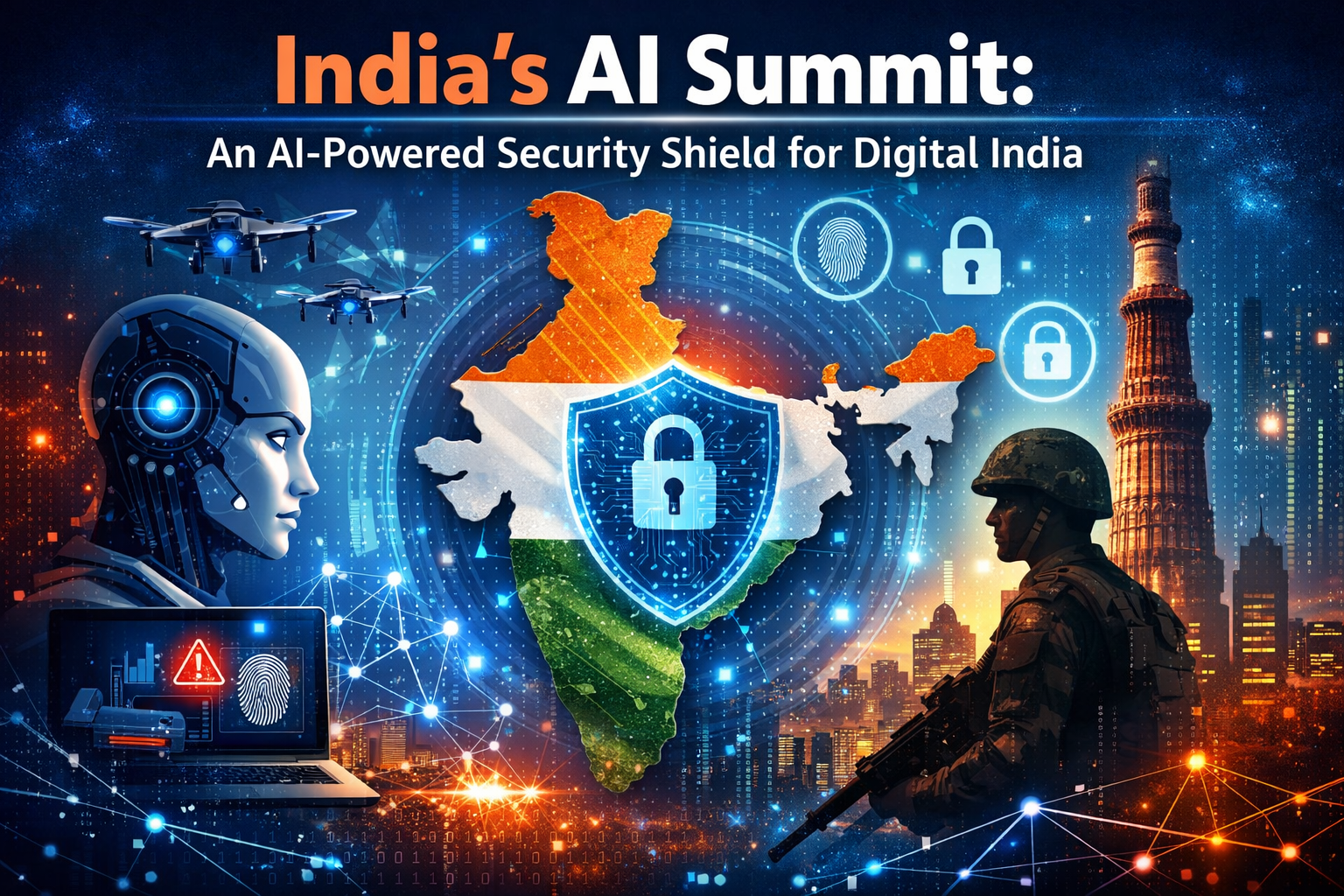
India’s AI Summit : An AI-Powered Security Shield for Digital India
The India AI Impact Summit 2026, held from February 16 to 20 at Bharat Mandapam in New Delhi, marked a historic milestone. With participation from over 250,000 delegates representing more than 100 countries—including French President Emmanuel Macron, Brazilian President Lula da Silva, United Nations Secretary-General António Guterres, Google CEO Sundar Pichai, and OpenAI CEO Sam Altman—India became the first developing nation to host a global AI summit of this scale .
Several new AI tools and products focused on cyber security were launched or showcased at the summit, making it a significant step toward strengthening India’s digital security framework . In this article, I provide an overview of the major AI tools, products, and policy proposals related to cyber security that were introduced during last week’s summit.
Why Cyber Security Became a Central Theme
Artificial Intelligence is often described as a double-edged sword. On one hand, it can transform healthcare, education, and agriculture. On the other, it can be misused for creating deepfake videos, conducting banking fraud, and stealing personal data .
Recognizing this dual nature, a special session titled “AI-Powered India: Fighting Deepfakes, Dark Web and Cyber Fraud” was held on February 17 . The message was clear: AI must be used for protection, its misuse must be prevented, and “AI should be countered with AI.”
Key AI Tools and Initiatives Announced at the Summit
1. Zero Trust AI Security Framework
One of the most discussed ideas at the summit came from Jay Chaudhry, CEO of global cyber security firm Zscaler . He emphasized the concept of “Zero Trust Security.”
In simple terms, Zero Trust means no person or software is automatically trusted. Every access request must be verified each time. Instead of relying on a large digital “fence” and assuming everyone inside is safe, this system checks identity and permissions at every step .
Several major Indian banks and large corporate companies are adopting this approach, and Chaudhry even noted that Indian banks are ahead of many Western banks in cyber security preparedness .
2. Historic Partnership Between IBM and the Government of India
Another major announcement was a partnership between IBM and the Government of India . Under this agreement, IBM will train 100,000 young Indians in Artificial Intelligence, cyber security, and quantum computing.
This initiative is expected to build a strong talent pipeline capable of defending India against next-generation cyber threats .
3. Privacy-Protecting AI
Among the startups showcased at the India AI Expo, PrivaSapien Technologies drew significant attention . Their technology allows data to be used for research and other purposes without revealing personal identity.
For example, a patient’s medical data can be used for research without disclosing their name or address . This represents an important step in balancing innovation with data privacy.
4. AI Security for Indian Enterprises
Secure Blink, an Indian startup, demonstrated its AI-based cyber security tools at the summit . The software automatically detects vulnerabilities in company computer systems.
This is especially helpful for small and medium-sized enterprises that may not have large IT security teams . In simple terms, it acts like a smart security guard who regularly checks whether your digital locks are functioning properly.
5. Deepfake Detection Technology
Deepfakes—AI-generated fake videos or audio—have become a major threat worldwide. At the summit, it was announced that the Government of India has provided special grants to IITs to develop technologies for detecting deepfakes and embedding digital watermarks in AI-generated content .
Such watermarking systems could help identify whether a video or audio clip has been artificially generated, thereby protecting citizens from misinformation and fraud.
6. National AI Research Grid
The proposed National AI Research Grid aims to bring together universities, startups, and government institutions under a shared advanced computing infrastructure .
Cyber security research has been given special priority within this grid. Even smaller institutions without access to high-end computing resources will benefit from this shared infrastructure .
7. AI Tools Demonstrated by the Indian Armed Forces
The Indian Army also showcased several dual-use AI technologies . Among them:
- EKAM – for secure handling of sensitive information
- AI-In-A-Box – for secure AI deployment in remote or disconnected areas
- ExFace – a facial recognition system for system security and identity verification
These technologies highlight how AI can serve both civilian and defense applications.
Conclusion
The India AI Impact Summit 2026 demonstrated that cyber security is no longer a secondary concern—it is at the heart of India’s digital transformation . From Zero Trust frameworks and privacy-preserving AI to deepfake detection and national research infrastructure, the summit outlined a comprehensive vision for safeguarding Digital India.
However, as repeatedly emphasized during the summit, AI is a powerful tool. Its benefits will depend on how responsibly it is governed and implemented. The future of Digital India will not only be shaped by technological innovation but also by strong cyber laws, ethical frameworks, and skilled human resources.
