Copyright Strikes : A Complete Guide for Content Creators
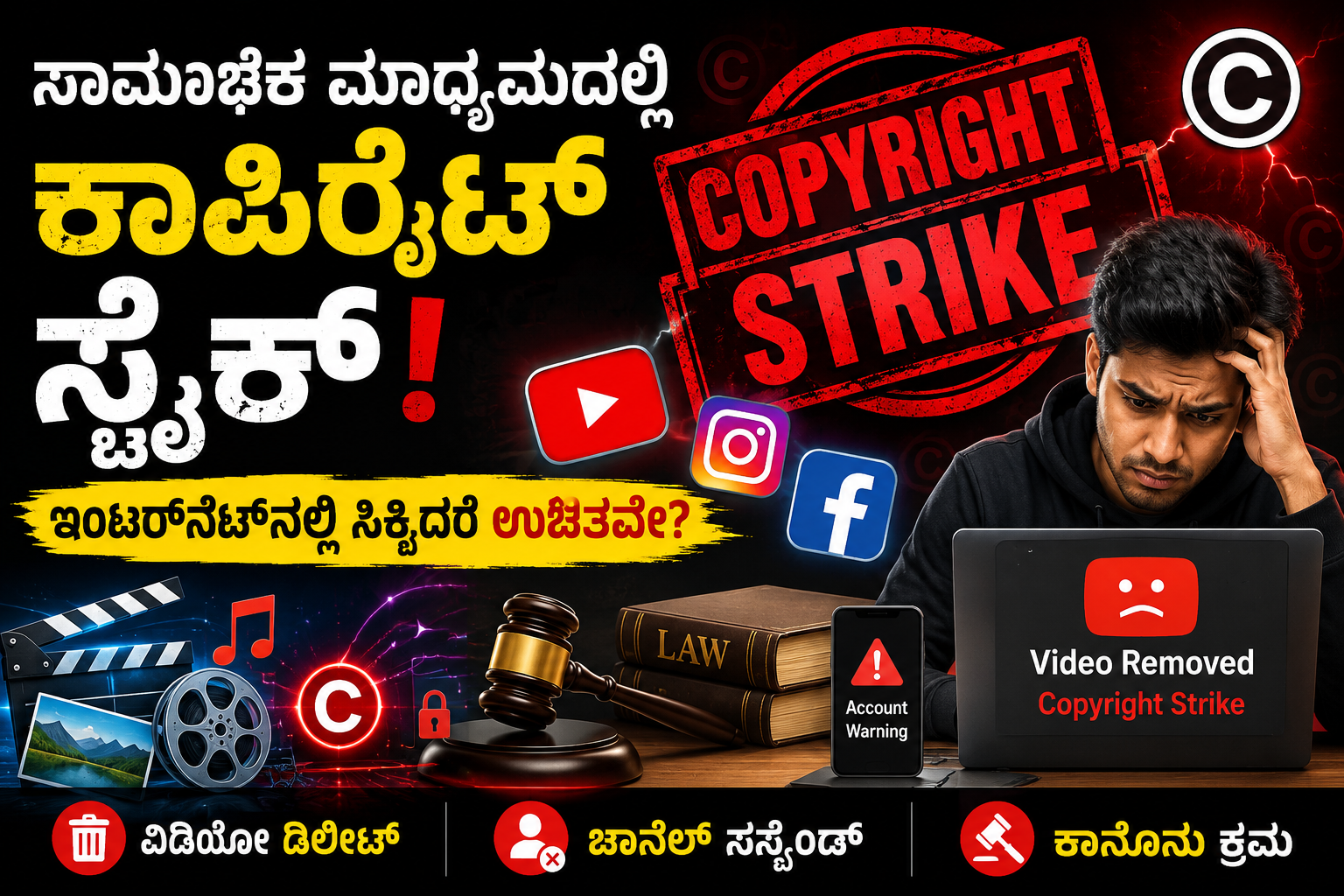
In recent years, countless young people, homemakers, entrepreneurs, and professionals have started creating content on YouTube, Instagram, and Facebook. From cooking videos and music covers to product reviews, comedy clips, and cricket highlights, people are sharing all kinds of content online. Then one day, many creators receive a shocking notification: “Your video has been removed” or “You have received a copyright strike.” Their immediate reaction is often, “What did I do wrong?” Have you ever experienced something similar? Many people genuinely believe they have done nothing wrong, yet their videos are removed or their accounts are suspended due to copyright violations.
One of the biggest misconceptions today is that anything available on the internet is free to use. People assume that if a photo, article, song, or video is publicly accessible online, they can use it however they like. Unfortunately, that is not how copyright law works. Every piece of content available online has an owner. Some creators attempt to protect themselves by adding statements such as:
- “Credits to the original owner.”
- “I do not own this content.”
- “This is for entertainment purposes only.”
- “No copyright infringement intended.”
However, such disclaimers do not provide legal protection. Using someone else’s copyrighted work without permission can still constitute copyright infringement. So what exactly is a copyright strike? Why does it happen? What does Indian law say about it? And how can creators protect themselves? Let’s explore these questions in simple terms.
What Is Copyright?
Copyright is a legal right granted to creators for original works produced through their skill, creativity, and effort. If you compose a song, write a story, create artwork, take a photograph, develop software, or produce a video, you automatically own the copyright to that work. In simple words: “My creation, my rights.” Copyright protects various forms of creative expression, including:
- Literature
- Music
- Films
- Paintings and artwork
- Photographs
- Software
- Videos
- Poems and other written works
Under Indian law, copyright generally lasts for the creator’s lifetime plus sixty years after their death.
What Is a Copyright Strike?
When you use copyrighted content without authorization on a social media platform, the copyright owner can file a complaint against you. Based on that complaint, the platform may remove your content. This action is commonly known as a copyright strike. For example, imagine you upload a video that contains a newly released movie song. The rights to that song belong to a music company. If the company files a complaint, your video may be removed and your account may receive a copyright strike.
How Copyright Enforcement Works on Social Media
1. Copyright Claim
A copyright claim is generally a softer form of enforcement. Your video may remain online, but:
- Advertising revenue may be redirected to the copyright owner.
- The video may be blocked in certain countries.
- The owner may track viewership and usage.
2. Copyright Strike
A copyright strike is a formal legal complaint. The copyright owner submits a takedown request, often under laws similar to the Digital Millennium Copyright Act (DMCA). The platform then removes the content. A single strike can restrict certain account features. However, repeated strikes can lead to severe consequences.
3. Legal Action
In serious cases, copyright owners may pursue legal remedies through the courts and seek financial compensation or damages.
How YouTube Detects Copyrighted Content
YouTube uses a sophisticated system called Content ID. Whenever a video is uploaded, Content ID scans every second of the content and compares it against a massive database of copyrighted material. If it identifies matching music, movie clips, television footage, or other copyrighted content, it automatically generates a claim or warning.
What Happens If You Receive a YouTube Copyright Strike?
- First Strike: Restrictions on certain channel features, including uploads and live streaming for a limited period.
- Second Strike: Additional penalties and temporary suspension of certain activities.
- Third Strike (within 90 days): Permanent termination of the channel.
In many cases, YouTube may not allow the creator to open another channel under the same identity.
Facebook and Instagram Copyright Violations
Facebook and Instagram also actively enforce copyright policies. If you download someone else’s reels and upload them as your own, or use copyrighted music without authorization on business pages, your content may be removed. Repeated violations can result in:
- Account restrictions
- Monetization loss
- Temporary suspension
- Permanent account disablement
What Does Indian Copyright Law Say?
Copyright protection in India is governed by the Copyright Act, 1957, along with amendments that address digital media and online content. Under Indian law:
- Copyright generally lasts for the creator’s lifetime plus sixty years.
- Copyright infringement can result in imprisonment ranging from six months to three years.
- Monetary penalties and damages may also be imposed.
- Repeat violations can attract harsher consequences.
What About Reviews, News Reporting, and Educational Content?
A common question arises:
“If using someone else’s content is prohibited, how do movie reviewers, news channels, and educators use clips from films and videos?”
The answer lies in the principle of Fair Dealing under Section 52 of the Copyright Act. Fair Dealing permits limited use of copyrighted material for specific purposes such as:
Criticism and Review :
Using short clips to analyze or review a movie, song, or other creative work.
News Reporting :
Using limited portions of content to report current events and public interest matters.
Education and Research :
Using material for teaching, learning, academic discussion, and research.
However, there is an important point to remember: YouTube does not decide whether your use qualifies as Fair Dealing. Ultimately, a court determines that.
How to Avoid Copyright Strikes
Use Royalty-Free Music
Utilize music from YouTube Audio Library, royalty-free music providers, or properly licensed sources.
Create Original Content
The safest approach is to create your own videos, voiceovers, images, and graphics.
Understand Fair Use and Fair Dealing
Use only the amount of content necessary for criticism, review, commentary, or education.
Check Before Uploading
Use platform tools that identify potential copyright issues before publishing.
Maintain Documentation
Keep records of licenses, permissions, and communications granting usage rights.
What Should You Do If You Receive a Copyright Strike?
Contact the Copyright Owner
If the violation is genuine, politely contact the owner and request withdrawal of the complaint after removing the infringing content.
Submit a Counter-Notification
If the claim is false and the content genuinely belongs to you, you can file a counter-notification, often with legal assistance.
If the complainant fails to pursue legal action within the required timeframe, the platform may restore the content.
Wait for the Strike to Expire
For first-time violations, strikes often expire after a specified period, provided no additional violations occur.
Final Thoughts: Let Your Hard Work Remain Yours
Social media platforms are no longer merely entertainment channels. For millions of people, they have become sources of livelihood and business growth. Creating quality content requires creativity, planning, filming, editing, and countless hours of effort. Why risk your channel and reputation by using someone else’s work without permission? Success built on copied content is temporary. Create original content. Use AI and modern tools to enhance your creativity. Respect copyright laws and the hard work of fellow creators. Because when you respect another creator’s rights, you also protect your own.
