
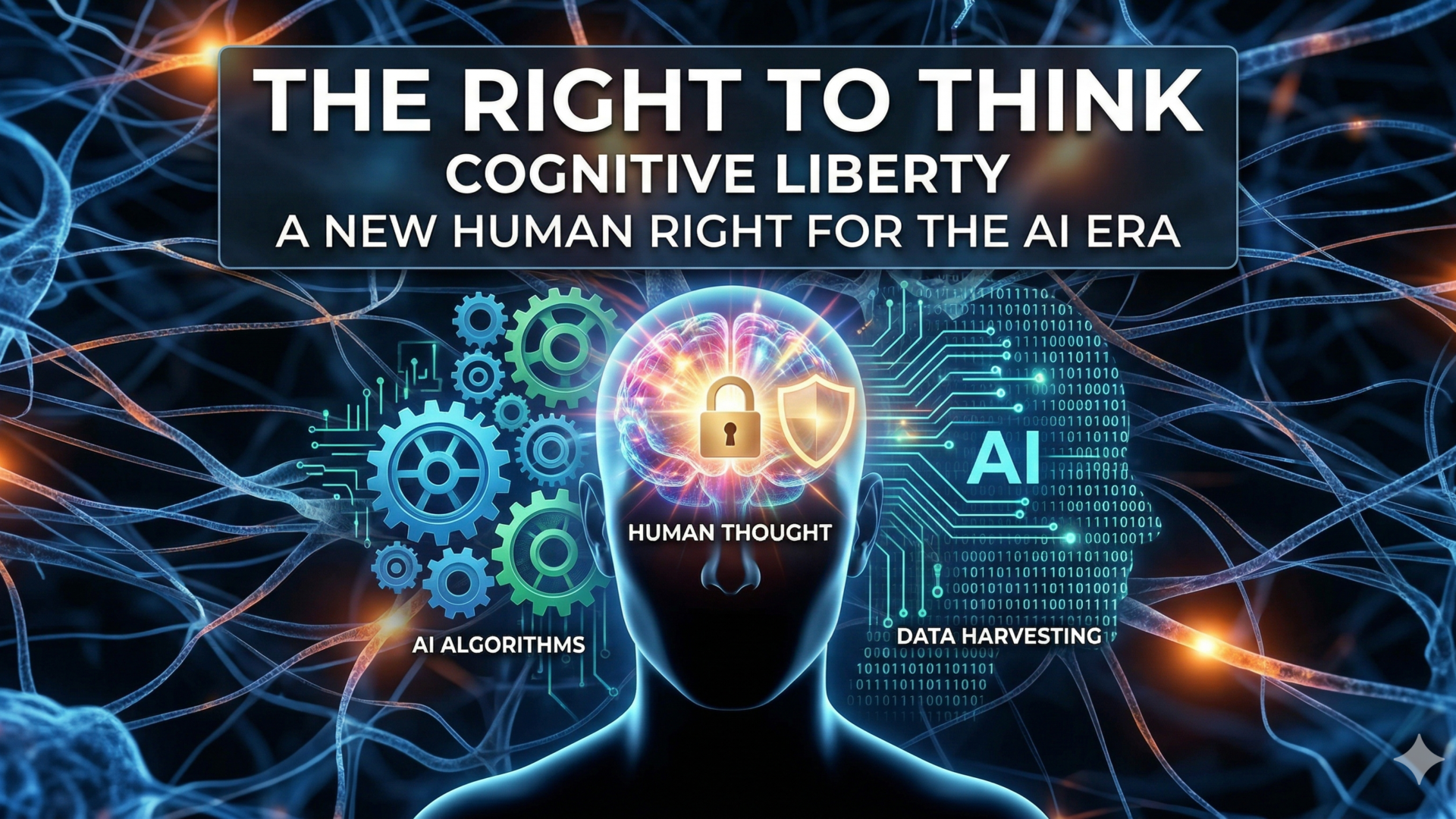
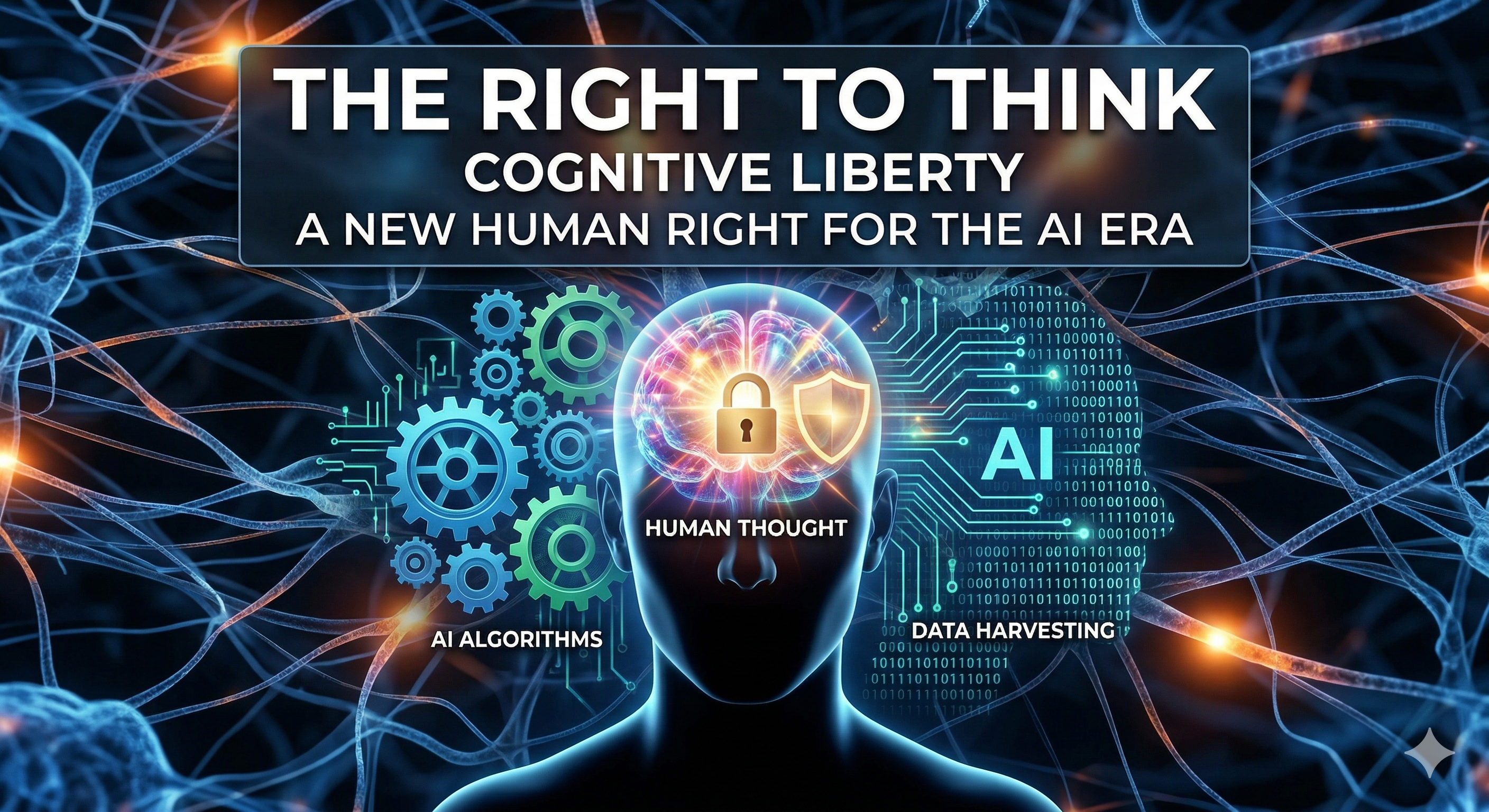
“The Right to Think”: A New Human Right for the AI Era
Last Sunday, In a seminar titled “Education in the Age of AI (Artificial Intelligence),” an audience member asked Dr. Gururaj Karjagi a poignant question: “Is the use of AI compromising the independent thinking power of students?”. Coincidentally, while browsing LinkedIn couple of days later, I came across an article by senior advocate Dr. Prashant Mali titled “The Right to Think: Cognitive Liberty will become a Fundamental Right in the Age of AI”. While our Constitution provides six fundamental rights and the Supreme Court has expanded these through various judgments, I believe the day is not far when the “Right to Think” will join this list.
Do You Really Own Your Thoughts?
Think about your morning routine. Did you pick up your phone and start scrolling immediately?. Have you noticed how YouTube, Instagram, or Facebook seem to know what you like even before you do?. This raises a vital question: Are your thoughts truly your own, or is a computer program thinking on your behalf?. This isn’t just a philosophical debate; it is an urgent social crisis. Experts warn that if we do not stop AI algorithms from silently shaping our emotions, political views, and stances, we are looking at the most profound loss of freedom in human history.
The Cambridge Analytica Wake-up Call: In 2018, it was revealed that the company ‘Cambridge Analytica’ harvested the psychological profiles of 8.7 crore Facebook users to influence the US elections and Brexit. By tracking what you ‘liked’ or clicked, they identified your intellectual vulnerabilities and served targeted ads to decide your vote for you. This wasn’t just data theft; it was the theft of your thoughts.
New technologies and new risks
Technologies like Elon Musk’s Neuralink are trying to connect the human brain directly to computers.
While this could help people with paralysis, it also raises serious concerns:
- What happens to the privacy of our thoughts?
- What if brain signals are hacked?
- What if companies start selling our mental data?
If that happens, even our thoughts may lose their value.
What Exactly is the “Right to Think”?
Most of us understand the Freedom of Expression—the right to speak what is on our mind. However, the “Right to Think” (also known as Cognitive Liberty) is different. It protects the pre-expression stage: the process where an opinion or belief is formed inside your mind.
According to Dr. Prashant Mali, this right rests on five key pillars :
Pillar Description 1. Prohibition of Mental Interference AI algorithms should not be allowed to control our subconscious mind or use techniques to change our stances without our awareness. 2. Cognitive Privacy Our brain data and thought patterns must be treated as strictly private. Violating this should be a punishable offense. 3. Epistemic Autonomy We have the right to access diverse information. Algorithms shouldn’t narrow our perspective by only showing one side of an issue. 4. Mental Integrity Protection from technologies designed to cause intentional psychological harm or damage mental health. 5. Right to Self-Determination We must decide how much AI interferes in our life decisions. We should have the right to refuse AI-driven advice for major life choices.
The Risk of “Cognitive Atrophy”
The excessive use of Generative AI tools like ChatGPT or Google Gemini is gradually reducing our ability to think deeply or analyze. Experts call this ‘Cognitive Atrophy’—effectively the “loosening of the brain’s muscles”.
Previously, searching Google and cross-referencing multiple sources provided exercise for the brain. Now, tools like Perplexity, SearchGPT, or Microsoft Copilot provide direct answers, often making our minds passive. Furthermore, the ‘Echo Chamber’ effect ensures the algorithm only shows you things you already agree with, narrowing your thinking over time.
The Global and Indian Context
- Chile (2021): Became the first country to include ‘Neurorights’ as a fundamental right in its constitution. In 2024, its Supreme Court even penalized a company for collecting consumer brain data.
- European Union (2024): The EU AI Act prohibits AI systems that exploit mental vulnerabilities or use subliminal techniques to change behavior.
- USA (Minnesota, 2024): Formally recognized the ‘Right to Mental Privacy’ and ‘Cognitive Liberty’ in its laws.
- India: While the DPDPA 2023 protects data, it remains silent on mental autonomy. However, the 2017 ‘Puttaswamy’ judgment noted that “privacy of the mind is as important as privacy of the body,” providing a constitutional foundation for the Right to Think under Articles 21 and 19(1)(a).
Our Responsibilities: Individual, Government, and Corporate
For Individuals:
- Review and change your privacy settings regularly.
- Avoid sharing deeply personal information with AI chatbots.
- Set online time limits for children and try ‘Digital Fasting’.
For the Government:
- Update the DPDPA to include mental autonomy.
- Create a specialized division within the 1930 Helpline for AI-related mental exploitation complaints.
For Companies:
- Ban “Dark Patterns” designed to manipulate users.
- Ensure algorithmic transparency and follow human-centric ethics.
Final Word
This isn’t just a legal question; it is a question of our humanity. AI should be our assistant, not our master. We must ensure that our mind remains the final frontier of human freedom.
