


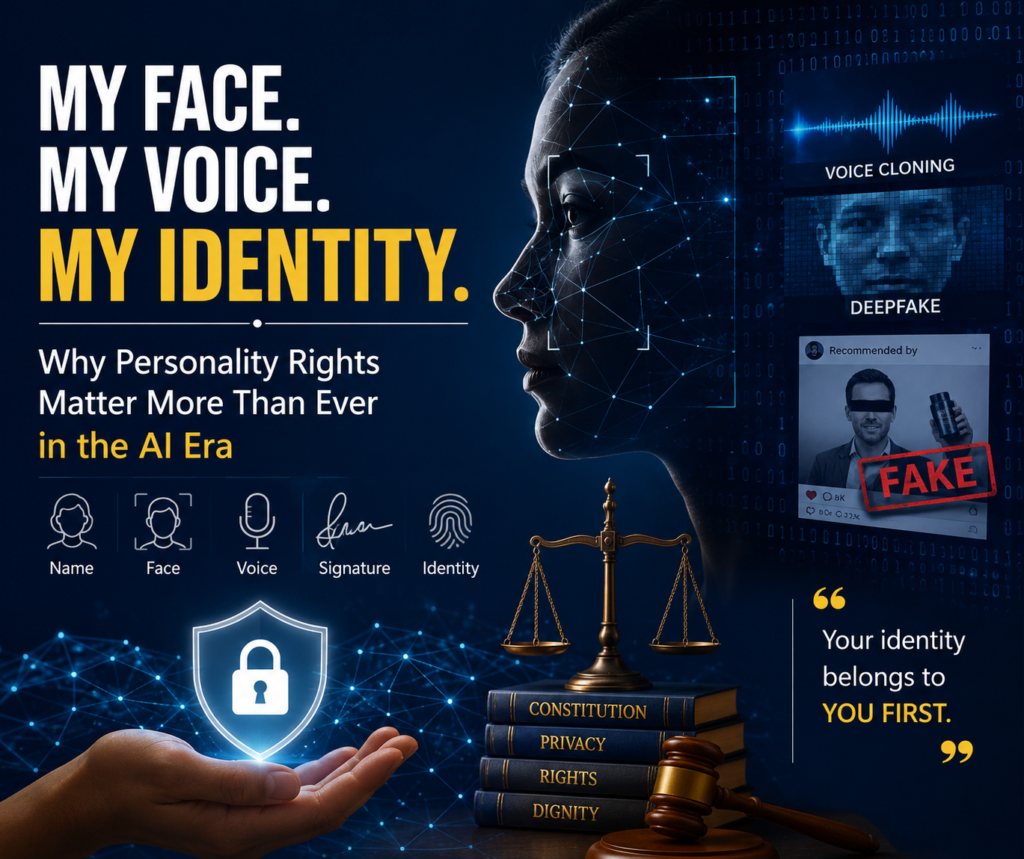


A few years ago, identity theft mostly meant stolen passwords or hacked bank accounts. Today, in the age of AI and deepfakes, identity theft has taken a far more personal and dangerous form.
Within minutes, AI tools can now:
- clone a celebrity’s voice,
- create fake videos using someone’s face,
- generate deepfake speeches,
- or falsely show a public figure endorsing a product they have never even seen.
But this issue is no longer limited to celebrities.
If someone uses your photograph in a fake advertisement, creates a fake social media profile in your name, or manipulates your voice using AI — your personality itself can become vulnerable to exploitation.
This is where “Personality Rights” become critically important.
What Are Personality Rights?
Simply put, Personality Rights are the legal rights a person has over:
- their name,
- face,
- voice,
- signature,
- image,
- likeness,
- distinctive expressions,
- and personal identity.
These rights prevent others from commercially exploiting or misusing your identity without your permission.
For example:
- Using an actor’s photo in a fake advertisement
- AI voice cloning of a singer or politician
- Deepfake videos spreading misinformation
- Fake apps or products launched using a celebrity’s identity
- Unauthorized merchandise using someone’s image
All of these may amount to violations of personality rights.
Why This Issue Is Exploding in the AI Era
Artificial Intelligence has dramatically lowered the barrier to digital impersonation.
Today, anyone with basic software tools can:
- create realistic fake videos,
- mimic voices,
- generate synthetic images,
- or spread misinformation at scale.
This has created serious concerns around:
- privacy,
- consent,
- reputation,
- misinformation,
- cyber fraud,
- and digital dignity.
Deepfakes are no longer merely entertainment experiments. They are increasingly being used for:
- scams,
- political propaganda,
- fake endorsements,
- cyberbullying,
- and online harassment.
India’s Growing Legal Recognition of Personality Rights
India still does not have a dedicated “Personality Rights Act.” However, courts are increasingly recognizing these rights through constitutional protections, intellectual property laws, privacy principles, and common law doctrines.
Several prominent personalities have approached courts in recent years, including:
- Amitabh Bachchan
- Anil Kapoor
- Jackie Shroff
- Aishwarya Rai Bachchan
- Shilpa Shetty
- Shashi Tharoor
These cases show how rapidly the legal landscape is evolving.
Key Legal Framework in India
1. Article 21 of the Constitution of India
The Right to Life and Personal Liberty under Article 21 has been interpreted by the Supreme Court to include:
- privacy,
- dignity,
- autonomy,
- and control over personal identity.
The landmark Justice K.S. Puttaswamy vs Union of India judgment recognized privacy as a fundamental right.
This judgment forms the constitutional foundation for personality rights in India.
2. Copyright Act, 1957
Section 38 – Performers’ Rights
Protects actors, singers, dancers, and performers from unauthorized use of their performances.
Section 38A – Moral Rights of Performers
Prevents distortion or misuse of performances in a manner harmful to reputation.
3. Trade Marks Act, 1999
Section 2(1)(zb)
Provides protection to well-known trademarks and famous identities.
A celebrity’s name or likeness cannot ordinarily be commercially registered or exploited without consent.
4. Digital Personal Data Protection Act, 2023
This law recognizes personal data such as:
- names,
- photographs,
- voice recordings,
- and digital identifiers.
Consent becomes central to lawful use of such data.
5. Information Technology Act, 2000
Section 66E
Punishes violation of privacy involving unauthorized sharing of images or videos.
Section 66D
Punishes cheating through impersonation using digital technologies.
These provisions are becoming increasingly relevant in AI-based frauds and deepfake scams.
Landmark Indian Court Judgments
Amitabh Bachchan Case
The Delhi High Court granted protection against unauthorized use of:
- his name,
- image,
- voice,
- and personality attributes in fake advertisements and lotteries.
Anil Kapoor Case (2023)
The Delhi High Court restrained misuse of:
- his image,
- voice,
- and iconic phrase “Jhakaas.”
Importantly, the court acknowledged the growing threat posed by AI-generated impersonation.
Arijit Singh Case (2024)
The Bombay High Court dealt with AI voice cloning concerns and observed that even technology platforms enabling unauthorized cloning could potentially face liability.
This marks a major development in AI accountability jurisprudence in India.
Global Perspective
United States
The “Right of Publicity” is strongly protected in many US states.
Even after death, celebrity estates may commercially control names and likenesses for decades.
European Union
The GDPR framework provides strong protection over digital identity and personal data.
Europe also recognizes the “Right to be Forgotten.”
United Kingdom
The UK primarily protects personality rights through:
- privacy law,
- passing off,
- and common law principles.
Personality Rights Are Not Just for Celebrities
One common misconception is that only film stars or public figures enjoy these protections.
That is incorrect.
Ordinary individuals also have rights against:
- fake profiles,
- unauthorized use of photographs,
- AI-generated impersonation,
- cyber harassment,
- and misuse of personal identity.
In many cases, the impact on ordinary citizens can be even more severe because they may lack legal awareness or institutional support.
The Need for Stronger Laws
India’s current legal framework is evolving, but it remains fragmented.
As AI technologies advance rapidly, India may eventually require:
- a dedicated personality rights law,
- clearer AI liability standards,
- deepfake regulations,
- and stronger platform accountability mechanisms.
The proposed Digital India Act is expected to address some of these emerging concerns.
Final Thoughts
In the digital age, identity itself has become a form of property.
Your:
- face,
- voice,
- image,
- and digital presence
now carry social, reputational, and commercial value.
The question is no longer merely “Who am I?”
It is increasingly becoming:
“Who controls my digital identity?”
As AI continues to reshape communication and content creation, personality rights will become one of the defining legal and ethical issues of our time.
And perhaps the most important principle emerging from courts across the world is this:
Your identity belongs to you first.